
By Popular Request, Ralphie’s Paw Prints
Into the Land of the Clock-Watchers, The Bohemian Bookstore, and Kings without Kingdoms
The books you are about to read follow the beginnings of the troubadour tradition and their tales of noble Knight Errantry fashioned out of music, poems and grandiloquent prose that evolved in France in the 12th century. It all started with Eleanor of Aquitaine who was married to both the king of France and England. She was a very wealthy woman having inherited all of Aquitaine from her father and therefore was not dependent upon her husbands, as well known and wealthy as they were, to maintain her own court. She therefore conducted a court of high culture with artists and poets and scholars in residence. And she even instituted Courts of Love in which the rules of chivalric courtly behavior were identified and established.
Her daughter Marie de Champagne, when she left home, took a substantial fortune with her and established her own Love Court in La Region de Champagne. At her court she was a patron of the literary arts, and it is claimed that her court created the first stories and traditions that we all have later come to know as the traditions of the Arthurian legends. The truth is that English writers took poetic license with the epic stories that originated at her court, in which she herself dictated the most important story plot of the love triangle between Lancelot and Guinevere, and she should have been given co-writer status for the Legend of Sir Percival and the rest of the four books that started the troubadour traditions of chivalric literature and made them their own.
In fact, her main advisor and champion, the poet Chretien de Troyes, wrote most of the beginnings of these traditions later picked up by Thomas Malory in his version of the Round Table tales La Morte D’Arthur and elaborated upon satirically by Miguel de Cervantes in Don Quixote and then brought up to date by T H White in his work The Once and Future King (1958). These fellow writers are what are referred to as Chretien’s Continuators. And it is a tradition to re-write these tales according to these new writer’s sensibilities. This brings us to The Epic Adventures of Prince Ralphie which are a series of stories about a wanderlust personality that believes in all things chivalric related including the rich philosophies behind the Chivalric Code.
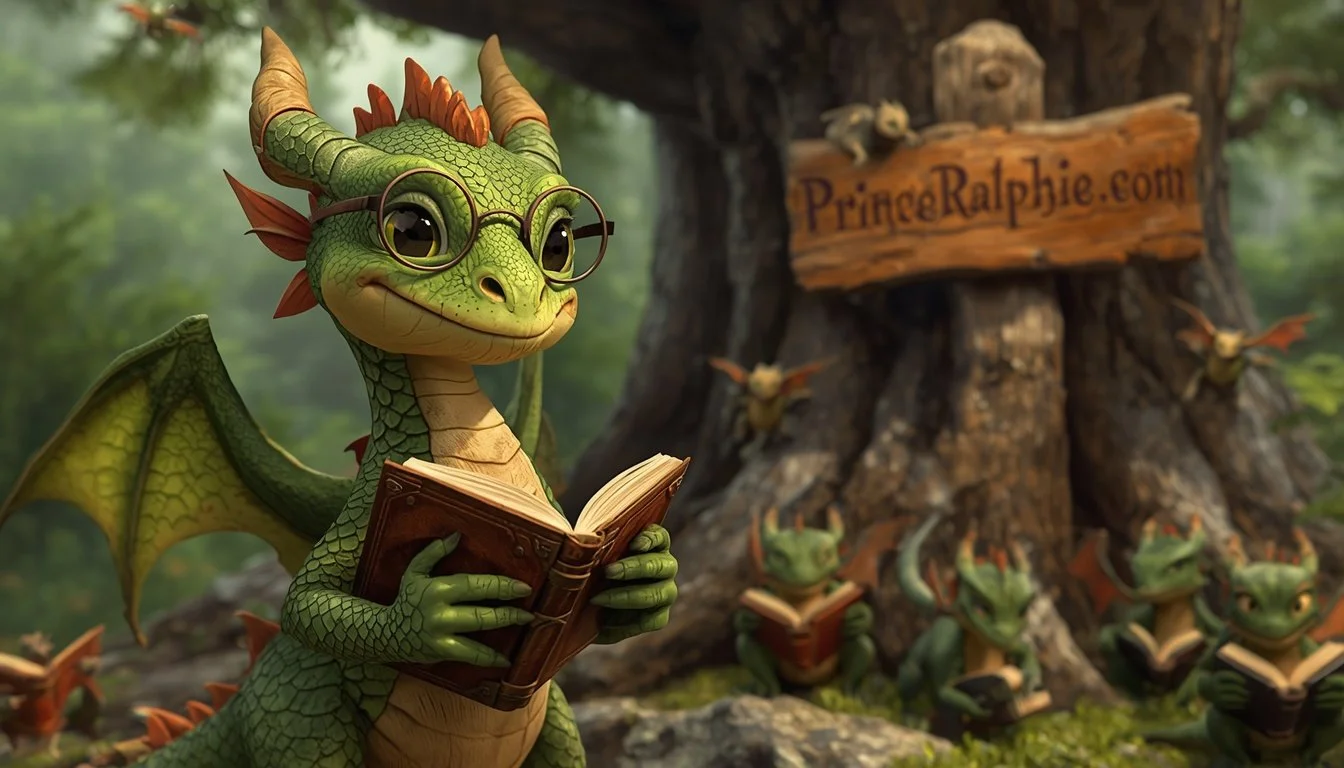
The books in the Epic Adventure series are an attempt to fill in some of the missing parts in the legend of Sir Percival as lived out by a very curious dragon who is under the spell of the legend. Why a dragon you might ask, and rightly so, and not a young boy as in the actual legend; it has to do with poetic license. For one, dragons, meaning any dragon, as everyone knows are mythological, which means they are creatures of literature and therefore are very malleable to play different roles in different stories, and they also have a great historical provenance, and in the case of green ones, a charming charisma.
They were first seen on the steppes of Russia and flown into battle by the Sarmatians in the fourth and fifth centuries B C. They called them Dracos, which is where we get the word dragon from, and painted them red on their flags to make them seem fierce, but the green ones didn’t have a malicious bone in their bodies. They were actually born without malicious bones, but that didn’t mean they couldn’t act resolutely. They were reluctant to be involved with violence, the green ones, but because other dragons, meaning the Bronze dragons and their minions in the particular, were determined to make the point through violence that ‘might makes right’ the green dragons were compelled from time to time, to deploy their collective literary wisdom in proving, to those that listened carefully, that ‘might never makes things right.’ They did this by pointing out the flaw in such determinations by way of putting poetic justice in their tales.
Secondly, who doesn’t want to fly on the back of a dragon between his word-wings into unknown foreign countries and meet sophisticated historical personalities like Monet, and Moliere and the Great Medici, as well as live with and talk to them and even help some of them with their art and architectural projects? And who doesn’t like the theater, which is where Prince Ralphie spends most of his training time in France to become a proper knight errant? Theaters are notorious green dragon hangout spots because they blend in with all the other artists. so easily. So that traveling with a bon-vi-bon green dragon through the capitals and villages of Europe is possibly the best and only way to see the world with the eyes of a dragon, in our case a very well read bibliophilic green dragon who is extraordinarily observant for his age?
The following is a re-imaging of the Percival Legend in terms of the trials and tribulations of Prince Ralphie, peripatetic Knight Errant of the Kingdom of the Verbose and his adventurous questing in medieval France, Renaissance Italy and then on to the dawn of the Age of Enlightenment in northern Europe. It’s a fanciful tale through time as it is a loose outline that follows the western history of ideas that has given us the ‘modern’ world, bereft of its dragons and unicorns and snoods and fairies, as Ralphie explores where things could have gone so wrong.
The questions the books pose are as follows;


Ralphie is Sir Percival, and the series follow the quests of the famous Knight Errant that were first recorded by Chrétien de Troyes of Languedoc Castle France who put pen to parchment in the twelfth century to recorded some of them … these stores are simply a continuation of that legend with its own quests
In keeping with the theme of the Fisher King—the Wounded Healer, who is wounded in the thigh, a wound that doesn't allow him to inspire fertility in his kingdom—Ralphie does meet him, but in his youthful naiveté he does not ask him the right question that would heal the King … which would also thereby give Ralphie the answer to the riddle of the meaning of the quests of Sir Percival
The overall theme of the books is that the individual does have agency in their life in spite of their individual beginnings or trials and tribulations, and this is demonstrated in the challenge of the two Knights in the first book in which one dies and one limps away, and the old man that created Time tells Ralphie that he too will ‘one day will have to fight for something he believes in,” which is a theme explored in the later stories in the series … the issue of how to heal a wounded warrior or more precisely, how to make a wounded warrior into a wounded healer.




In depth psychology: this adventure is the exploration of the letting go of the Ego and the embrace of something bigger than the “Self” … the “Transcendent” which becomes a call to individual service of the Greater Good. The existential literary question in the previous books is: “Who does the Grail serve?” Which I believe can be interpreted as; “Who do you serve?” I know this is a controversial interpretation but from my reading the stories are manifesting a calling for the ‘individuation’ of the Knight Errant to become a philosopher King by fully understanding this last phase to maturity in understanding the purpose and meaning of one’s individual calling to serve others.
The Grail represents the “Transcendent” … and what you put in the Grail are the memories of your life, good and bad, and then you drink from it the wisdom of your life experiences, their meanings and purposes, and thereby your heart is calmed and peace and beneficence comes from that “new” perspective of the old.
The seeking of the Grail is a theme throughout the series, the how and wherefore of it, and the Grail, when drunk from refreshes the spirit of the seeker and allows him to “see” the world anew; as if “reborn” or “resurrected.”


In order to raise him with a value system without religious or ideological fetters his mother teaches him the Chivalric Code whose ultimate goal is to seek and find the Grail of legend and lore. Seeking the Grail is in metaphorical terms the same as seeking the spiritual.
Ralphie is raised by a single mother and is an only child, this goes to the heart of a single mother raising a boy without a male role model so that she builds a mythological backstory for his father that helps direct his footfalls ... in psychological terms it also goes to the sense of a child being both alone in the world and feeling special at the same time.
Ralphie came from an enchanted forest; it is, in metaphorical terms, the innocent, enchanted forest of very young youth. It’s a place where your food and clothes and getting you to school on time just sort of happens magically … for most kids.
The Clock-Watchers are the adults, in this iteration of the famous tale, they spend their time watching clocks and therefore can’t see unicorns or dragons or faeries or snoods, or most of the rest of the enchanting creatures the artists and dreamers and children can see.